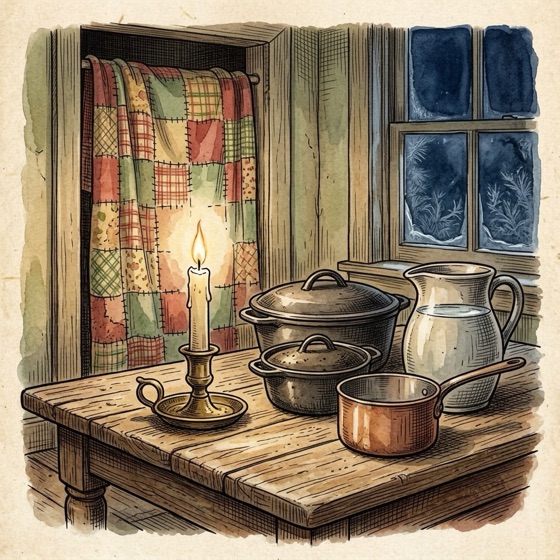
Part I
The First Night
Survive tonight before you plan a winter.
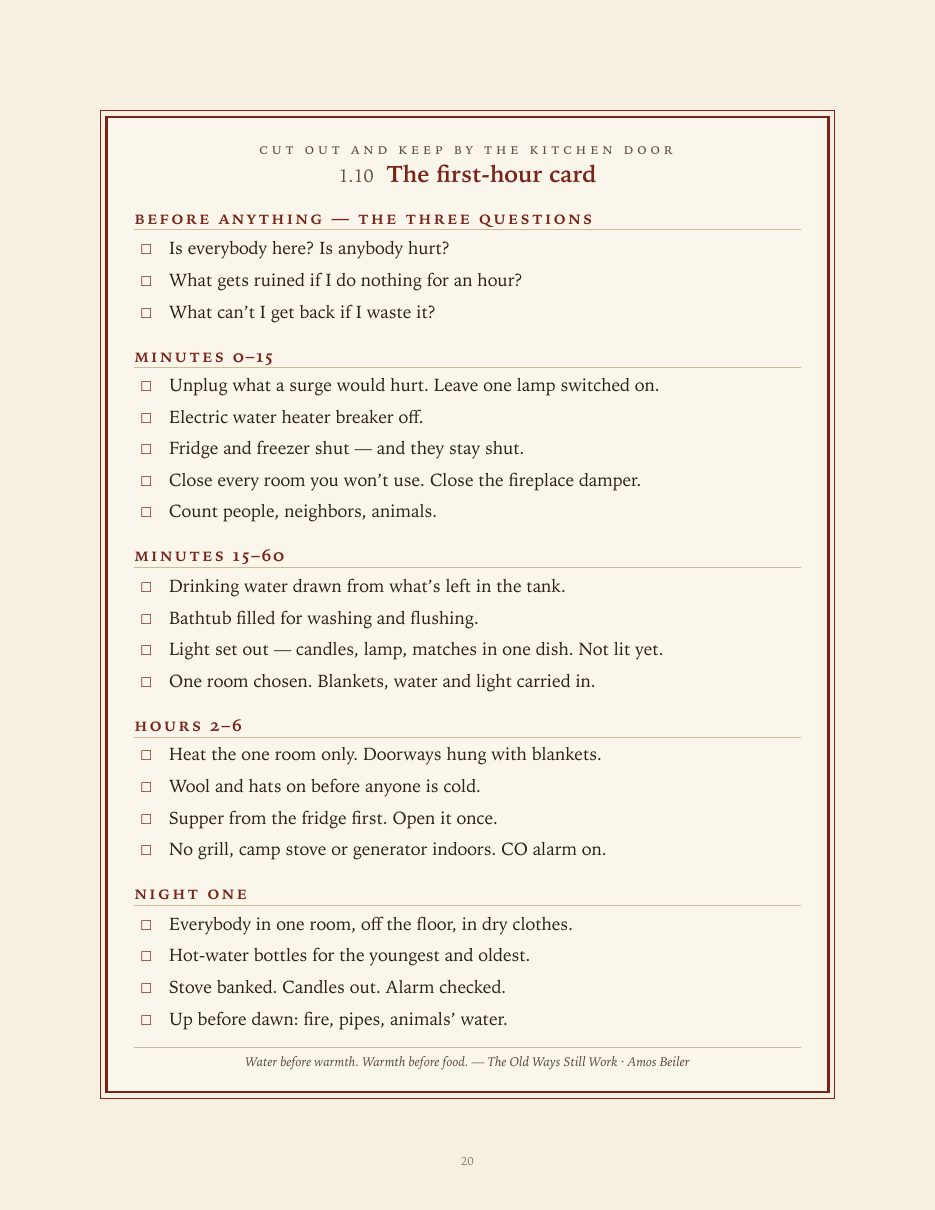
- The first hour, minute by minute — shut off, shut in, count people
- What fails first in a country house, and in what order
- The shelf that empties first, and what $50, $150 and $500 buy
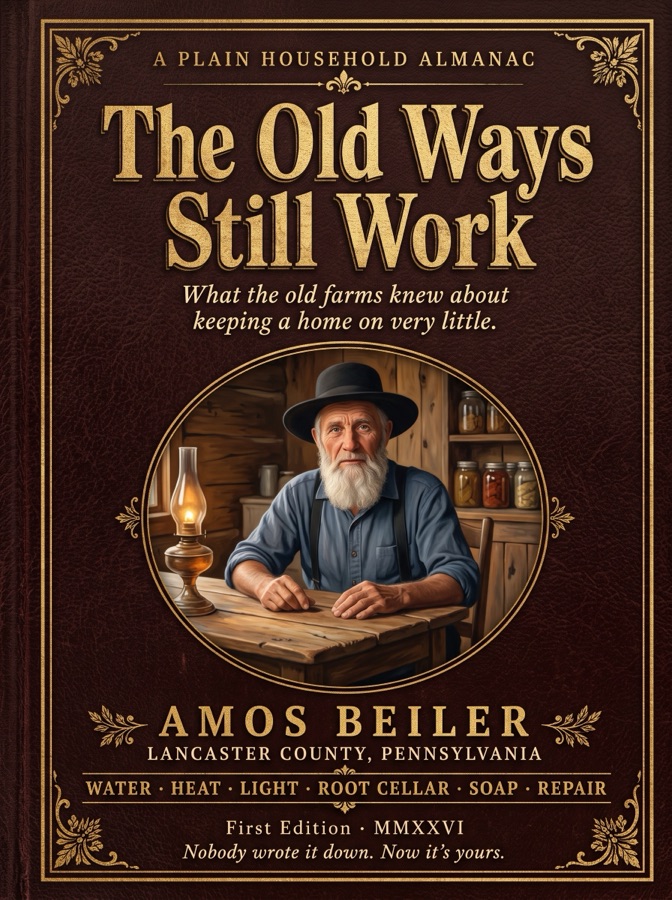
A Plain Household AlmanacNo. I
Water before warmth. Warmth before food. Food before the rest.
Your grandfather could keep a house going all winter on forty dollars a month — not because he was tough, but because he knew the order of things. The water came before the stove, the stove before the shelf. One warm room beat six cold ones, a candle outlasted a battery, and a jar of beans put up in August was worth more in February than a twenty-dollar bill. Nobody wrote it down. You learned it standing next to someone who knew. This is the writing-down.
🔒 Launch price — $20 off until December 31, then $57
See what’s insideInstant download · read it on your phone, tablet or computer, or print it at home · pay once, yours to keep

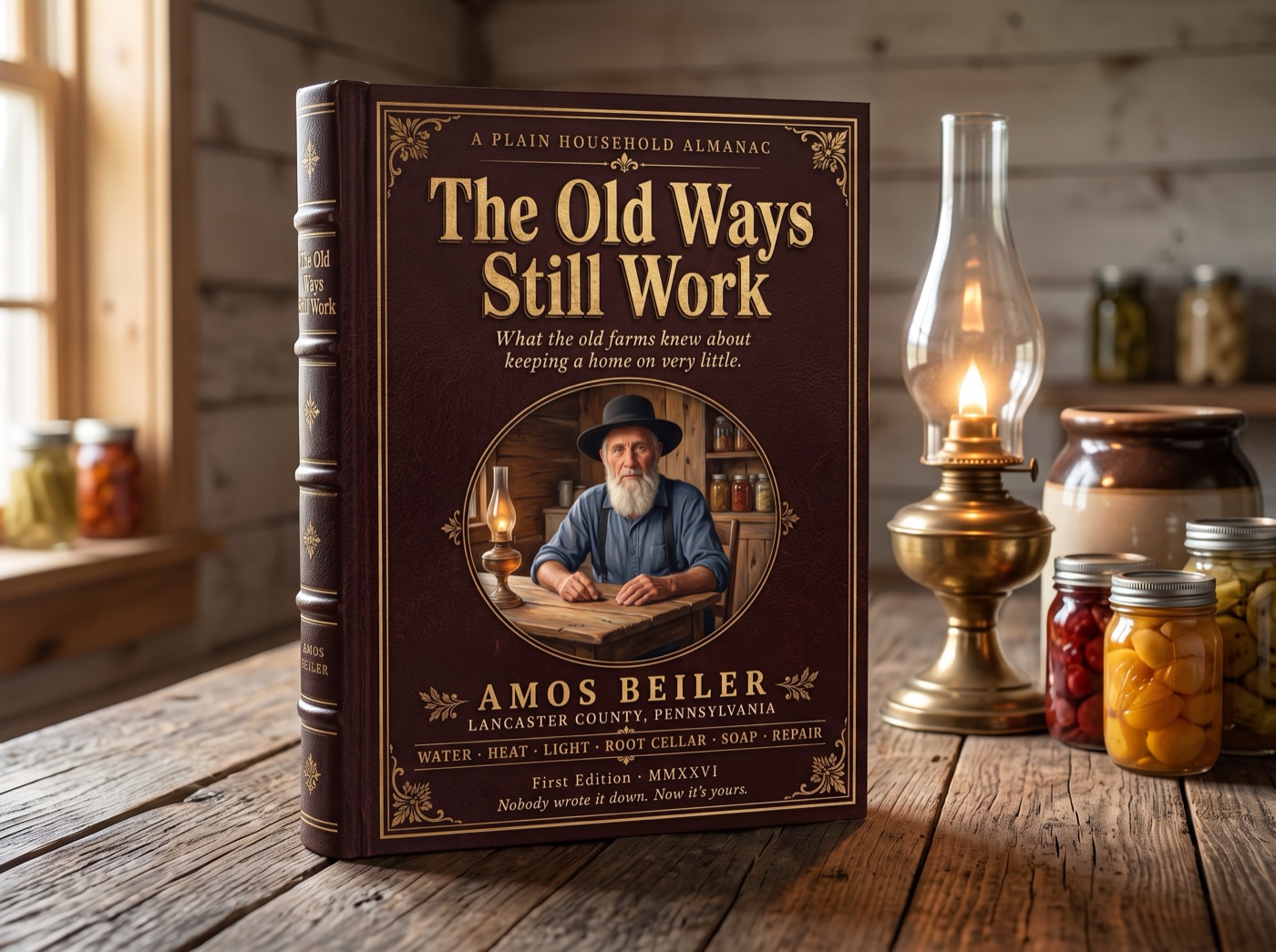
I. The Whole Book
21 chapters · 174 numbered sections · 324 pages · 21 printable cards
🔒 Launch price — $20 off until December 31, then $57
One payment, no subscription. Your download opens the moment payment goes through.
30-day money-back guarantee. Read the first chapter, try one thing. If it isn’t what you hoped, write within 30 days and every dollar comes back.
🔒 Secure checkout by Stripe · cards, Apple Pay, Google Pay — we never see or store your card.
II. The Numbers
Every heat source is a dollars-per-night number. Rank them and the decision makes itself. This is the table from chapter 7: one closed 12×14 room held at 55°F through a 14-hour night at 0°F outside.
| Heat for one cold night | About |
|---|---|
| Seasoned wood in a woodstove | $4 |
| Coal | $4 |
| Kerosene, bought at the pump | $7 |
| Vent-free propane, 20-lb tank refills | $11 |
| Kerosene, bought in hardware-store jugs | $17–22 |
| Tealights (and the book explains why not) | $37 |
| 1-lb propane cylinders | $45 |
Typical 2026 U.S. prices, worked out on paper in section 7.11 so you can redo them for your own house and your own fuel. Yours will differ.
The whole first night — light, heat and two meals for a family of four in one room — comes to about $14 (section 1.8). The expensive night is never the candles. It’s the freezer opened every hour, the pipe in the north wall, the generator bought at the worst price of the year. The difference is the order.
III. What’s Inside
When the power goes, a house loses things on a schedule: the grid, then water, then heat, then the shelves, then the money. The book is built on that line, so you always know what to do first.
Part I
Survive tonight before you plan a winter.
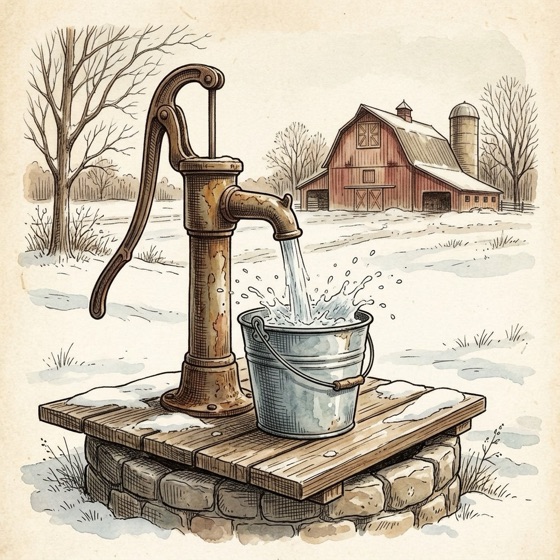
Part II
Nobody dies of hunger in three days. Everybody dies of thirst.
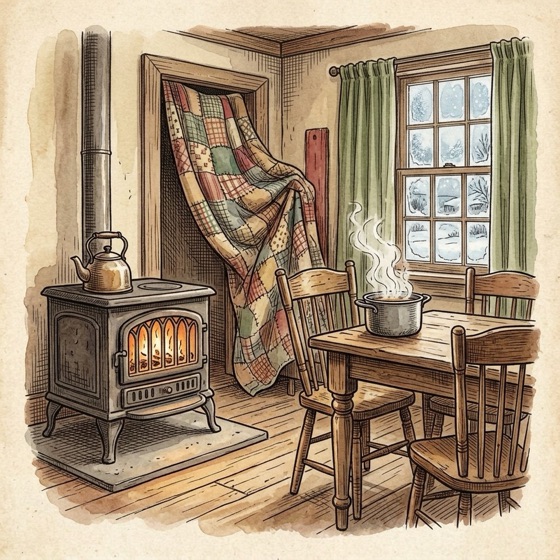
Part III
The part that decides whether you stay in the house.
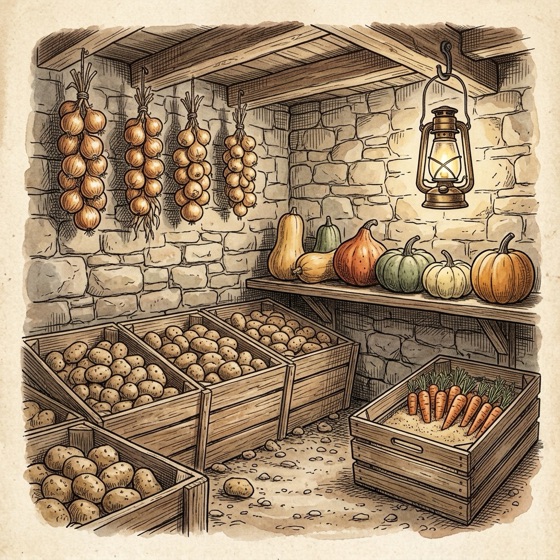
Part IV
The longest part, because it was the longest part of the year.
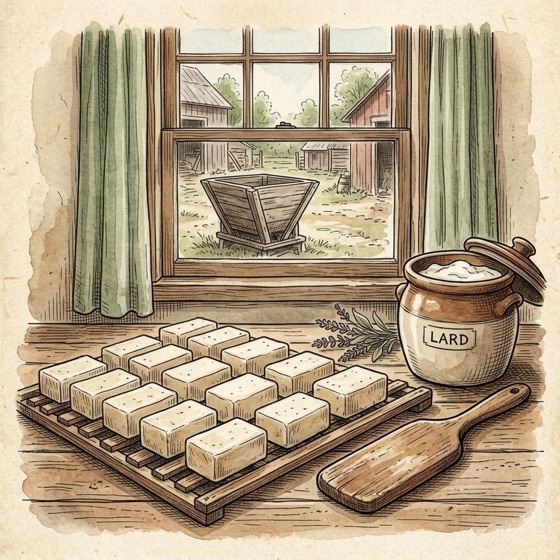
Part V
Where the money is actually saved.
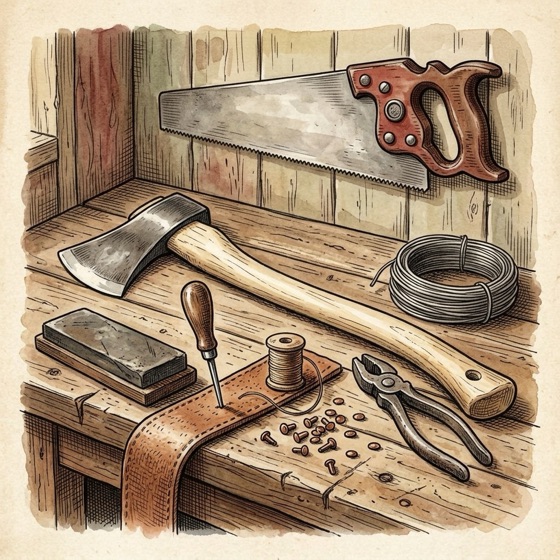
Part VI
The part that turns the book into a habit.
Plus the back of the book: buy-first lists at $50 / $150 / $500 / $1,500, every reference table in one place, where the old tools still come from, and a glossary and index.
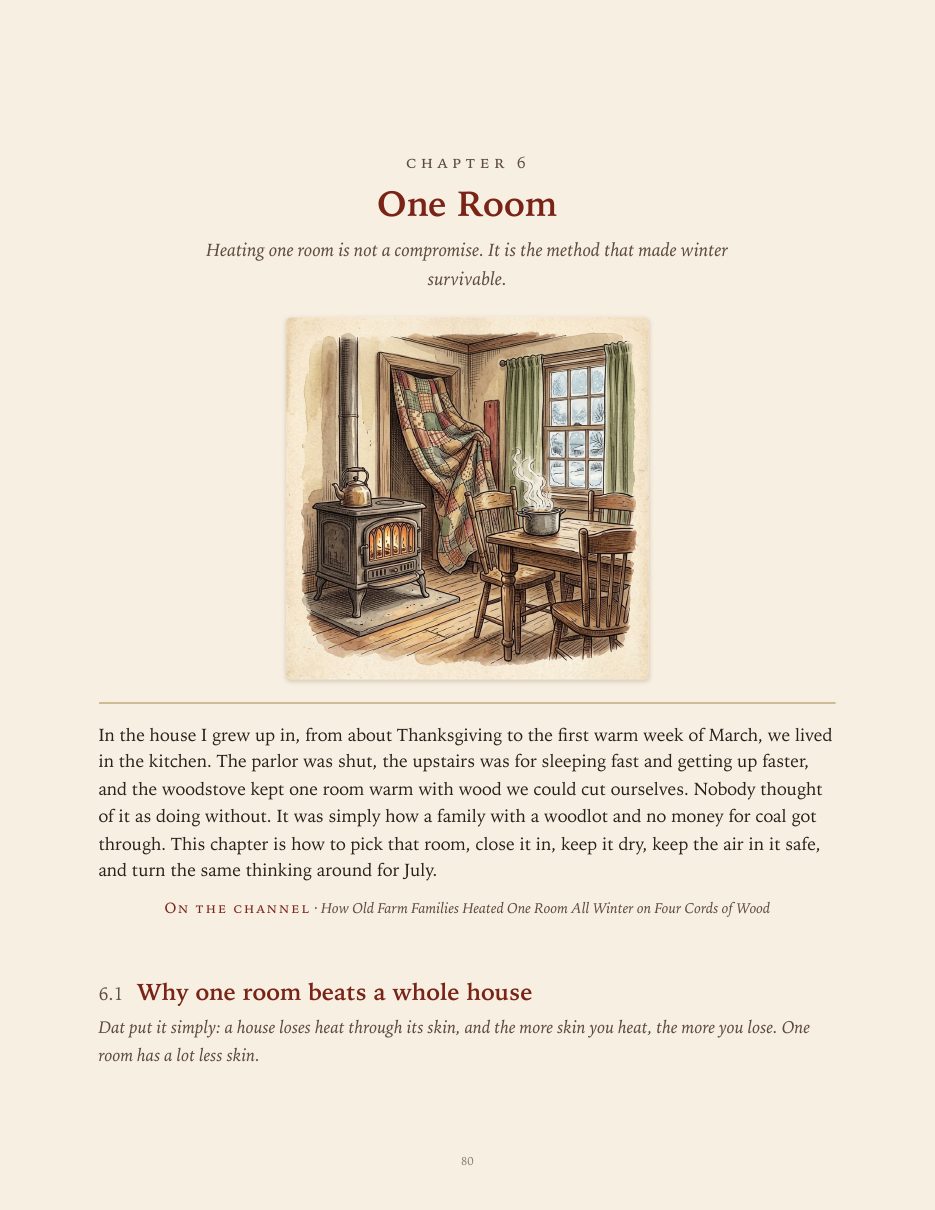
IV. A Look Inside
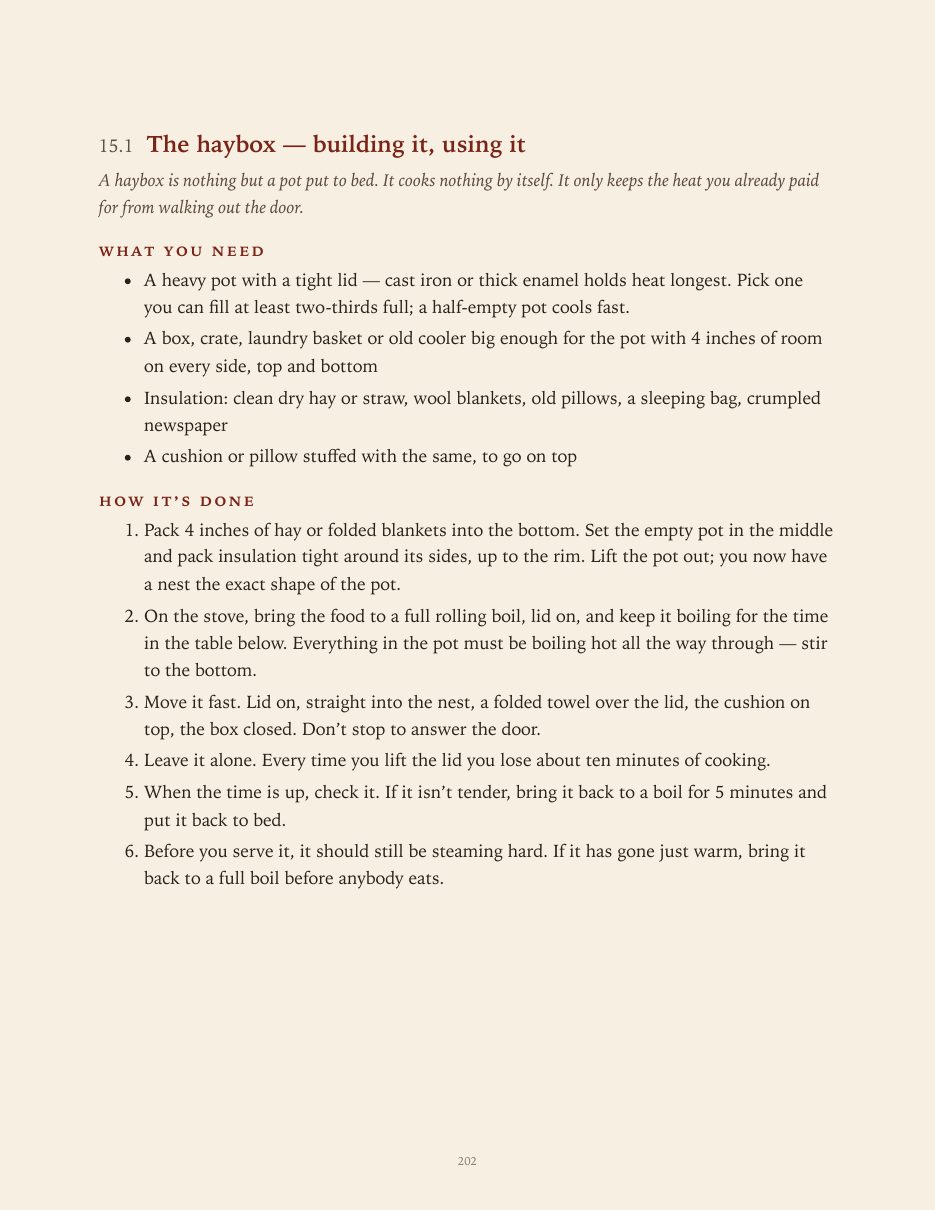
Every method has the same four parts: what you need, how it’s done, the by-eye way to know it’s right, and what to do when it goes wrong. Where a number decides whether something is safe — water, canning, curing, smoke — the book gives the current published guidance and says where it came from.
V. About Amos
I come from people who fixed what broke, grew what they ate, and kept a full pantry long before anybody called it prepping. My mother drew every pot full of water before the pressure tank gave out. My grandmother stood still in the dark for as long as it takes to say a short grace before she touched anything. None of them wrote a word of it down.
On my channel I pass those old ways along one at a time — keeping food without a refrigerator, stretching a dollar, heating one room, the simple repairs. This book is all of it gathered and put in order, with the arithmetic done on paper and the safety lines checked against what we know now, so you don’t have to guess.
Nothing fancy. Nothing you need to buy. Just what worked, explained slow enough to follow.
— Amos
Amos is a narrated character; the methods are drawn from traditional sources and current public-health guidance. Watch the channel →
VI. Get the Book
🔒 Launch price — $20 off until December 31, then $57
The download page opens right after payment, and Stripe emails your receipt. Lost the files? Get them again with the email you paid with.
30-day refund guarantee. If it isn’t what you hoped, write within 30 days and you get every dollar back.
🔒 Secure checkout by Stripe · Visa · Mastercard · Amex · Apple Pay · Google Pay
VII. Before You Start
No. The first night, the water math, one-room heat, light, the pantry and the repair bench all work in a town house or an apartment. Some chapters — wells, springs, hens — are for folks with land; you’ll know which ones to skip.
Three PDF files: the full book (324 pages, letter size), a large-print edition, and the 21 cards on their own. They open on any phone, tablet or computer, and print on ordinary paper at home or at a copy shop.
Not a bit. After you pay, the next page has three buttons. Tap one and the book downloads. Stripe also emails you a receipt. If you ever lose the files, go to the download page, type the email you paid with, and they’re yours again.
Some of them were. Old households were poisoned by their own stoves and wells. Where the old way got it wrong — carbon monoxide, radon, low-acid canning, drying raw meat — the book says so plainly and puts the modern safeguard right beside the old method, with the source (CDC, EPA, USDA).
No. The medicine-shelf chapter is about what a household kept on hand and how it stored and labeled it — not what to treat with it. When somebody is hurt or sick, you call for help.
No. It’s about staying — in your house, in your town — and keeping it running on very little when the usual things stop, and in the ordinary weeks too.
Yes — it’s yours to keep, print and hand down to the people in your house.
Write within 30 days of buying — reply to your Stripe receipt — and you’ll get a full refund.
❦
Chapter 1 in full — what to do in the first fifteen minutes, the first hour and the first night when the power goes — plus the first-hour card to tack up by the kitchen door.
We’ll write only when there’s something new from Amos. Unsubscribe any time.
There it is. Download the first hour (PDF) →
$37 once — the book, the large-print edition and all 21 cards. Read the first chapter tonight; if it isn’t what you hoped, one note gets a full refund.
$37 once · no subscription · 30-day refund guarantee · yours to keep and to hand down